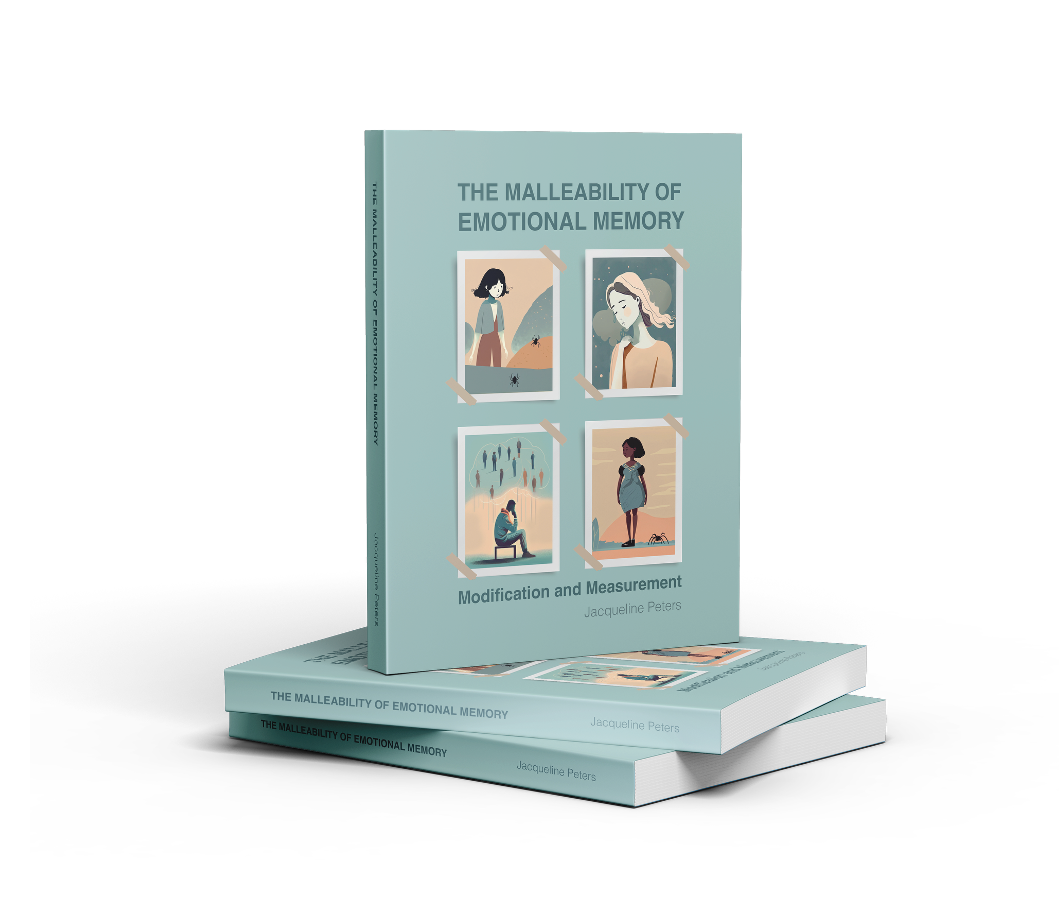
About my Doctoral Dissertation
Emotional memory plays a crucial role in guiding our behaviour, helping us to adapt and thrive in our ever-changing world. However, when emotional memory becomes maladaptive, it can lead to anxiety and related disorders. Fundamental research into fear learning and memory has opened new avenues for understanding and targeting maladaptive emotional memories via, for instance, reconsolidation interference. This is a process thought to directly weaken emotional memory, which may prevent relapse.
To improve psychological interventions, it is not only important to explore the malleability of emotional memory by investigating novel treatment mechanisms, but also to capture changes in emotional memory expression over time, which requires good measurement tools.
The overarching aim of this dissertation was to explore and capture the dynamic and complex nature of emotional memory.In the first part, we tested the effectiveness and translational value of a reconsolidation intervention, a treatment designed to modify maladaptive fear memories. This involved examining changes in self-reported fear and avoidance behaviour to better understand the temporal dissociation of emotional memory facets following treatment (Chapter II). The second part of this dissertation focused on improving the assessment of emotional memory and exploring how the act of measurement may affect emotional memory expression (Chapters III-V).
Together, the research presented in this dissertation illustrates when emotional memory expression does – or does not – change and thereby contributes to our understanding of the plasticity of emotional memory, offering insights relevant to improving psychological treatments.
Access code: 177235
The University of Amsterdam also wrote a short, accessible article about my doctoral research. This 2-minute read can be found here.
Published Chapters
The empirical chapters of this dissertation were published as peer-reviewed articles, and can also be found under publications.
Peters, J., Filmer, A.I., van Doorn, J.B., Metselaar, V.N., Visser, R.M., & Kindt, M. (2025). Re-encountering the phobic cue within days after a reconsolidation intervention is crucial to observe a lasting fear reduction in spider phobia. Molecular Psychiatry. 1-10.
Peters, J., Visser, R. M., & Kindt, M. (2022). More than just fear: Development and psychometric evaluation of the Spider Distress Scale to assess spider fear and spider-related disgust. Journal of Anxiety Disorders, 90, 102602.
Peters, J., van Wonderen, A., Visser, R.M., & Kindt, M. (2025). The act of measurement: The influence of behavioural tests on spider fear and disgust. Journal of Psychopathology and Behavioral Assessment. 47(3), 62.
Peters, J., Freund, I. M., Kindt, M., Visser, R. M., & van Emmerik, A. A. P. (2024). Convergence of real-time and retrospective assessments: A systematic investigation of naturally occurring and experimentally induced intrusions. Journal of Behavior Therapy and Experimental Psychiatry. 101981